Wednesday, September 19, 2012

Marriage: Not Life or Death

This is going to be a little bit more opinionated that my usual blog posts. The topic has come up more times than I can count this week. Not just with myself and my significant other, but other people in my life who are single or not currently married. I did some research on it, but the research is very limited.   

I am at the time of my life where a lot of my friends are getting married or having children. It seems that a new wedding invitation pops up in the mail every few months as of late. Now, I am very happy to see my friends get married on a very special day and start their lives together. I think it is a beautiful time in people's lives. People who are married or getting married, this blog post is not aimed at you or your marriage, I promise. I don't hate marriage, I don't wish that all marriages will fail, ECT.

My boyfriend and I have been seeing each other for a little over six years. He is currently finishing up his degree and I am working full time and working towards my Master's degree. We do not live together nor do we share the same bank account. Marriage has been a discussion, but not something that needs to be done right away. I want him to be able to succeed and finish his education, just in case something happens that leaves him to live an independent life.

However, if we walk into a gathering of people who are currently married, nine times out of ten we will receive one of more of the following questions:

*I should note, again, that this isn't every married couple in the world. This isn't intended for a specific group of friends, acquaintances, or otherwise.   

1. "So, when are you two getting married?"
2. "Oh. Six years? And you're not married yet?"
3. "You're waiting till he graduates? Wow. That's selfish."
4. "You'll regret not getting married young."
5. "Oh! We can have a married couples get together!"
6. "I don't know how you live without being married."
7.  Having someone plan your life around you getting married to one another. (My favorite!)
8. "Why don't you just get married? I mean, you've been together forever."

What is our response? We laugh, get nervous, or we begin to fall into what Elisabeth Noelle calls "Spiral of Silence" (Media Effects, 29). Noelle describes it as "The perpetual fear of isolating themselves and carefully monitor public opinion to see which views are acceptable. When their opinions appear out of favor, they keep silent" (Media Effects, 29). We could go into discussion as to why we aren't married or why we think marriage shouldn't be a rushed event but, that sends us backwards or escalates the conversation. We're not looking to upset our married friends and we don't want people to create false opinions of us based on our answers. 

What do we want to say? We're not ready for that type of commitment or we want to be able to get our own lives together before looking into that or we just are looking forward to spending time together right now.

How should non married couples/single persons respond to such questions? Why do people ask such questions? This also applies to single persons as well. If someone hits a certain age, the question is still the same except "you two" changes to just "you". In most cases, both sides of the conversation have communication barriers.

There are hundreds of reasons that a communication barrier(s) might be brought into a conversation. Most of these reasons can be condensed into seven different types of barriers: physical, perceptual, emotional, cultural, gender, language, and interpersonal. The above example is best described as either an emotional, perceptual, or cultural barrier. Emotional barrier can refer to either the sender, receiver, or both. When you walk into a conversation, you might immediately assume someone's emotional state which will curb your responses. This is the same the other way around on the sender's side in which their emotional state creates irrelevant statements or statements that cause sender's to say, "I didn't mean it like that". 

The cultural barrier is very important to the example of marriage discussion. People grow up in a world that is getting smaller in thought processes by the day. You have to also be able to look in the culture that they grew up in to better understand their statements. This leads into perceptual barriers, which are caused by different world views. This can begin in cultural barriers. Perceptual barriers can cause a person to speak based on their own personal experience or perception of the world. 

It is possible that this communication can stem from people being happy in their married life and they want you to be happy, too. It is also possible that they enjoy time with their married friends. The reasons can vary from person to person and couple to couple. Everyone is going to be different in every location around the world. However, this should be taken into account when the question or statement is posed to an non married person or couple. 

So, what should be done in this situation for the sender and receiver? 
  • Acknowledge your own biases first
  • Look through the lens of those who are least likely to align with your views
  • Listen.
  • Fashion your message to include something that everyone can relate to.
The most difficult part about communication is attempting to understand someone's worldview. You are not going to be able to be able to communicate effectively if you don't at least attempt it. This is directed to both sides of the conversation. Once you're able to understand someone's views - understand, not agree in most cases - you are able to have an open discussion that might lead to new information about the person. 

Also, ask non-defensive open ended questions. 

Instead of 
Why aren't you married?

You should try:
What are your thoughts on marriage?

This allows for a healthy discussion. Open ended questions are very important when talking to someone about a topic. "What are your thoughts on marriage?" can truly make a difference in a conversation as it is not accusatory nor does it come off blatantly offensive. If I was asked the open ended question, I would be able to discuss and explore different opinions on different subtopics of marriage and I might learn something from the other person.

In conclusion, remember to take into account a person's world view and their personal experiences before becoming enraged or offended. Marriage is not a life or death situation that will make or break you as a person or a couple. You should always respect people's opinions on such topics, even if you do not agree with them. If someone tells you they don't want to talk about it or they seem offended by your question or response, move on to the next topic. Does this mean stop talking about marriage? No. In fact, be happy with your significant other and be excited about your wedding day. Just don't worry about everyone else. 

Friday, September 14, 2012

Dr. Pepper: Evolving Into a Huge Deal


All advertisements have a specific goal that they need to complete in order for it to be successful. Companies reach out through advertisements, whether their billboards or otherwise, to a specific marketing group that gives them the most feedback. Sometimes companies will participate in what I like to call blind-suicide marketing, which is a marketing strategy that the company does not see a loss of consumers on a simple idea.

Dr. Pepper is a B2C company which means that they follow the guidelines of business to consumer. Their marketing campaigns that are sprinkled all over the world attempt to reach out to different consumers in the marketing grid after they research a cluster (customer profiles based on lifestyle, demographic, or shopping behavior).


Last year, Dr. Pepper marketing Dr. Pepper Ten, a diet coke version that has 10 calories. However, the ad was deemed as "sexist against females" because the audience stated that diet versions are "gross" and "too feminine". Dr. Pepper stated:

"Men, in particular, are dissatisfied with the taste and image of diet drinks. The company wouldn't disclose the formula of Dr Pepper Ten, but said that the drink has 10 calories and 2 grams of sugar, which gives it a sweeter taste. Dr Pepper said there are 23 flavors in its regular soda, (which has 150 calories and 27 grams of sugar per can) and Dr Pepper Ten contains all of them."


So, this is not the first time that Dr. Pepper has been under the gun with advertisement issues. 


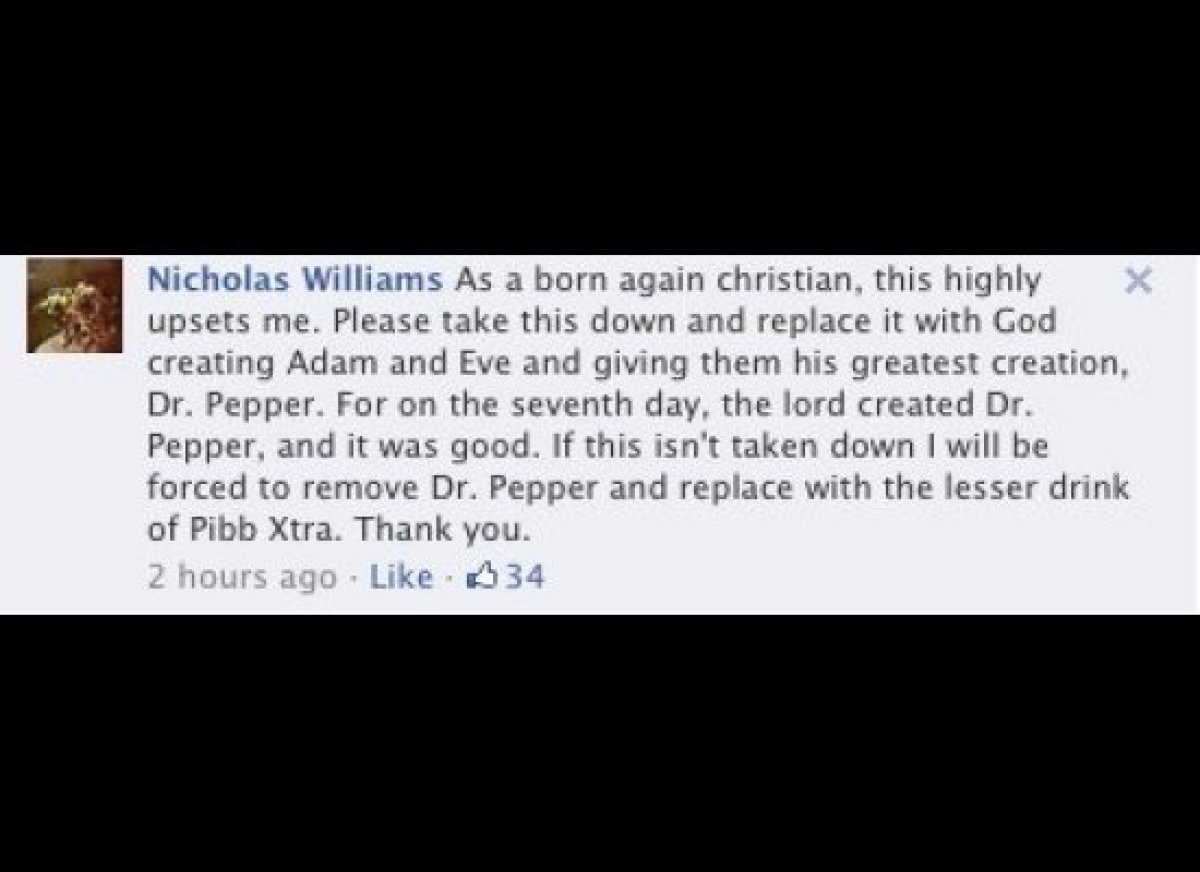
Their recent ad, below, has the tagline of "Dr. Pepper: The Evolution of Flavor". Most people might look at this ad as "clever" or "repetitive" as a lot of companies have used the Evolution approach. However, this was not the case. After putting up the ad on their Facebook, Dr. Pepper had 900 comments in just under an hour. Most of the comments were people upset that Dr. Pepper would "force" them to believe in evolution or "God being the Creator" and how false the advertisement was.

Let's look at the advertisement on a graphic design stand point. Dr. Pepper's main colors are white and maroon. They decided to go with a bolder color: red. According to Margaret Walch (Living Colors: A Definitive Guide to Color Palettes Through the Ages, 1995), red can be described as:

If you want to draw attention, use red. It is often where the eye looks first. Red is the color of energy. It's associated with movement and excitement. People surrounded by red find their heart beating a little faster and often report feeling a bit out of breath.

Dr. Pepper was successful in this as they wanted to grab attending to the audience. The other color used is white (and a lighter and darker red, but that gets counted in the above description). White is looked at as purity or perfection. When white is used in an advertisement, the consumer feels as if Dr. Pepper is "good". 

Silhouettes have not been prominently used by a large company since Apple's Silhouette campaign for their release of IPod. The forecast team (a team that predicts how well or poor a campaign will go in the market) stated that Apple would make no more than $400 million dollars in sales. With the use of their Silhouette campaign, however, they made 1.2 billion dollars in sales.

This ad, in marketing terms, is successful in getting the point across. With the faded logo in the background, this ad might even be listed under subliminal marketing. But, with the use of terms across the bottom, it is very specific as to what the company is selling. Also, the use of font is fantastic, bold, and to the point.
 
I am a person who has friends ranging from Pagan to Christian, so this is no way intended to shut down entire religious groups. However, the statements that were published on Facebook, were not the best representations of the ad itself. Dr. Pepper never states any type of anti-religion hate speech in their campaign. In fact, if anything, that is completely the opposite of their campaign.


This is just one of the many comments that were scattered across Dr. Pepper's Facebook page. Here's the issue, though.

If the advertisement said, "God created Dr. Pepper on the 7th Day" or "There is no God, we evolved from monkeys and they like Dr. Pepper", then absolutely. That marketing would be deemed offensive. However, the advertisement is simply showing an evolution of the company through minimalistic graphic design.

Finally, I want to take a look into why these comments are not effective in giving Dr. Pepper poor feedback. Pope John Paul II wrote to the Pontifical Academy of Sciences on the subject of cosmology and how to interpret Genesis:
"Cosmogony and cosmology have always aroused great interest among peoples and religions. The Bible itself speaks to us of the origin of the universe and its make-up, not in order to provide us with a scientific treatise, but in order to state the correct relationships of man with God and with the universe. Sacred Scripture wishes simply to declare that the world was created by God, and in order to teach this truth it expresses itself in the terms of the cosmology in use at the time of the writer. The Sacred Book likewise wishes to tell men that the world was not created as the seat of the gods, as was taught by other cosmogonies and cosmologies, but was rather created for the service of man and the glory of God. Any other teaching about the origin and make-up of the universe is alien to the intentions of the Bible, which does not wish to teach how heaven was made but how one goes to heaven." (John Paul II, 3 October 1981 to the Pontifical Academy of Science, "Cosmology and Fundamental Physics")
The "Clergy Letter" Project, drafted in 2004, and signed by thousands of Christian clergy supporting evolution and faith, states:
"We the undersigned, Christian clergy from many different traditions, believe that the timeless truths of the Bible and the discoveries of modern science may comfortably coexist. We believe that the theory of evolution is a foundational scientific truth, one that has stood up to rigorous scrutiny and upon which much of human knowledge and achievement rests. To reject this truth or to treat it as 'one theory among others' is to deliberately embrace scientific ignorance and transmit such ignorance to our children. We believe that among God’s good gifts are human minds capable of critical thought and that the failure to fully employ this gift is a rejection of the will of our Creator." ("An Open Letter Concerning Religion and Science")
From what I can gather, this specifically states that yes, God created the World and created Man. However, it also states that you can believe in evolution as it can co-exist with the story of Adam and Eve. That being said, this ad cannot be deemed as such since it specifically shows that the Evolution stops at the third picture: Man. You can believe in evolution as long as you believe that God is the one who helps it along and you don't deny His existence. This, of course, does not span across all religious sects since the Pope is not prominent in most religions that people have said. When you dig into the comments of that thread, Catholics are very dominant in saying that evolution is a sin and Catholics who believe in it will go to Hell.  

The final comment doesn't even make sense. There are still apes because apes are still evolving. Just because something is extinct, doesn't mean that they didn't have a predecessor in before them that they evolved into. The ad would be less effective if it was an evolution of a fish and the final form of the evolution was a fish drinking Dr. Pepper. Fish don't drink Dr. Pepper. Also, the ad would be entirely less pretty much pointless.

This ad is successful in their marketing campaign, regardless if they didn't think it was going to cause an issue. It hit the correct market clusters and was a beautiful formulated advertisement. I don't personally think that this advertisement should cause issue with evolution and creationism because the idea of both are supported by the Church and Christians.

~Meredith Gerber


Thursday, September 13, 2012

Instagram: Why it is Successful For Most


After my monthly rants about the new photography application known as "Instagram", I decided that it would be best to actually research the application myself. So, before I headed out to Portland last month, I downloaded the application before boarding the plane. 

Instagram was launched in October of 2010 and is a free photo-sharing application that also doubles as a social media tool. The application was only available for Mac users for awhile (Mac, IPhone, IPad) in the Apple Store. But, as of April 2012, Android users can now enjoy the same benefits as it is downloadable through Google Play. Instagram has swept the nation and has given entertainment to those who use it. 

This article is not for Instagram users. In fact, I encourage that you explore options when looking into photography. I encourage that you have a good time playing around with a free application. This article is for Instagram Photographers, the new breed of artists that have been sweeping the country. Most Instagram users get offended when I voice my opinion on the application because they don't understand where my anger stems from.

The appeal to the market is simple. When you're in Instagram, you have a few different options.

1. You can take a photograph with your camera phone or you can take a previously taken photograph and run it through a few filter options.

2. You can share your finished Instagram shots over the Instagram Feed. Followers can "<3" or "Comment" on the photograph. These posts can be showered in hashtags, which is "#" and then a word(s) or phrase relating to the photo. The term ‘hashtag’ comes from computer-coding: the symbol is a hash mark, and the term is a tag, thus ‘hashtag’. Hashtags were coined by Twitter in order to be able to search the site for an interest or an event. For example, if I take a photograph of my red shoes I am wearing today, I could post it as #redshoes. With that hashtag, people can search for the term "redshoes" and be able to locate my content.

3. You can comment or "<3" the photographs of your friends.

4. You can share across social media sites such as Facebook, Twitter, Flickr, and FourSquare. I chose to share it over Twitter and Flickr. 

At this point, I had figured out that the app works very similarly to most social media networks. I will admit that I had a lot of fun with it and as an entertainment application, I recommend that people use it as such. It does it's purpose of being fun and entertaining. As a consumer, I would say that the only issue I have with the application is the forced square box that crops your photograph entirely. As a photographer? This application is something that is more than frustrating.

However, I still stand by my statement that I had made a few months ago. Instagram does not make someone a photographer. I met a girl a few months ago who showed me her portfolio, asking me what she thinks she can do to improve her photos. I noticed that the photos were a little grainy and in low resolution but she had a technique for Photoshop edits. However, when I asked her what type of camera she used, she smiled and excitedly said, "My IPhone! Instagram is a great application!"

The low resolution and the blurriness of the photographs are "exciting" and "new" to people. However, to people who work with higher quality photographs on a day to day basis, it's frustrating to say the least. If you blow up an Instagram photo on a large poster, it won't have the same effect as it does online. When you blow up a photograph taken with a physical camera (with a decent amount of megapixels), you don't risk the memory not being as clear as you though it was. 

Even on high-end mobile phones, it is a depressingly inaccurate camera. Even a decent film camera has a resolution of between 12 to 20 megapixels. The iPhone 4 has 5 megapixels on the rear camera, and something like the EVO has 8 megapixels.

This is where my rants start from. The picture on the left (You can click it to see it up close) shows the manual process per filter. I have used most if not all of these methods by hand. Processing under their filters can take seconds on Instagram. Where as the actual process takes much longer than that.

Little known fact, however, is that in their Terms and Conditions, they clearly state, 
 ...By displaying or publishing (“posting”) any Content on or through the Instagram Services, you hereby grant to Instagram a non-exclusive, fully paid and royalty-free, worldwide, limited license to use, modify, delete from, add to, publicly perform, publicly display, reproduce and translate such Content, including without limitation distributing part or all of the Site in any media formats through any media channels, except Content not shared publicly (“private”) will not be distributed outside the Instagram Services.

Photographers who want to make a living off these photos, relinquish those rights when they use this application if shared publicly. Also, it states that they can reproduce and translate such content. That means that your photograph of your lunch for today is no longer yours. It belongs to Instagram now.

The recent trend of Instagram Professional Photographers have also taken a chunk out of the Photography Network. Most photographers I know use Instagram as a handy quick point and shoot tool. But, clients have turned to the new app as a means to define a photographer. This can lower photographers chances of said client. However, it isn't a situation where the photography business is dying. People still love film and digital photographs and some have never even heard of Instagram before.

Most people say, "But, photography equipment is expensive!". I absolutely agree with you. However, when photographers start out with basic cameras, they are able to learn the basics and gradually move up to better quality equipment. Just because Instagram is free, does not mean that it should be used as photography equipment that can be taken seriously in the field. However, over time you learn to budget and learn what equipment pieces work for you.

According to Alex Cowles of QueryClick, "Instagram is the new lens-flare. It's the new delusion. It's the new fake-authenticity that people crave." (Why I Hate Instagram) But, most trends die very quickly. If this application was ran entirely by users that were doing this for entertainment, I would be more than happy to support it. But, it is a mixed bag of entertainment users and Instagram photographers. However, Instagram photographers hopefully will come to a stop - whether it is their discovery of film or digital cameras or they realize that Instagram just does not make you a photographer overnight. 

~Meredith Gerber

Wednesday, August 29, 2012

Bic for Women: Not a Huge Deal

The other night, while my boyfriend and I watched Saturday Night Live episodes, a commercial for Bic Pens kept repeating every commercial break. At first, I didn't pay much attention to it. But, after the third or fourth time seeing it, I realized how terrible the advertising is.

I am in no way a person who rushes to the first mention of anything remotely sexist. In this aging population, there is consistent comments that I simply ignore. I am not a person who is a fighter for females only. Do I believe in equality? Absolutely. Do I think that a woman has to like feminine only items? No.

I looked high and low for this commercial, but after the backlash that Amazon is currently receiving, they have since pulled the commercial. 

A beautiful girl is in the hallway at the first day of school. She innocently asks for a pen. Immediately, a group of boys attempt to give her a normal Bic pen. She declines, giggling. Within seconds, the "Bic Guy" hands her a pen that she graciously takes. The pen is pink and thicker than the normal pen. The end of the commercial is her kissing the "Bic Guy" on the cheek. 

Let's look into the commercial itself. Bic, you have told me a few things:
1. Attractive females needs a writing utensil in a school environment because they will not have one.
2. Owning a regular Bic pen will not pull attention of said attractive female.
3. However, if you own a "Bic for Women" pen, you will immediately have said female go steady with you and ignore all other males.
4. You will move up in the social ladder of education.  

While marketing a pen for women might increase revenue, in this case, it backfired and did more harm than good.

The pen is marketed "for women". In Gawker.com's article called, Hilarious Amazon Reviewers Take on Bic’s Stupid, Sexist ‘For Her’ Women’s Pens, the writer quotes the marketing campaign as:

"Designed to fit comfortably in a womans hand" and with an "Attractive barrel design available in pink and purple." For reasons we can totally understand, Amazon reviewers find these pens very funny. 

After I read the reviews, I could see that the commenters were clearly making blatantly sexist jokes and comments. Some almost sounded believable, but their comments echo the same idea. 

I brought this concern to one of my social medias with the intent to disprove the marketing campaign. A few of my friends kept repeating the same question.

"What's the issue?"

The issue isn't that there are pens that are designed to fit comfortably or that they come in pink and purple. The problem is that it is marketed specifically towards women. There is no gender equality on the marketing aspect of it. The product is brilliant as I know a lot of people who think that the barrel of a normal Bic pen can be too thin or too rough. However, the marketing should focus on the comfort and the design as opposed to the push on women.

Also, the idea that you can make something pink, feminine, and floral and turn it into a better product for the female population is kind of confusing. If the pen was marketed appropriately and the "For Women" was taken out, then I can absolutely get behind that. 

Sure. There are some products that market towards women and should be marketed towards women. But, a pen - something that is universally used between sexes on a day to day basis - has turned into a marketing campaign only designed for females.

It's very hard to take apart marketing because most people view it like the normal population. It's a cute and fun way to market a new type of product. Most people view the comments to be funny and comical. But, does that mean that there has to be a "For Men" pen as well? Should there be a pen that is blue and black that has a rougher barrel? 

What about a pen that is marketed towards a left handed person? There are too many times that my hand will smear ballpoint ink or eraser pens. It is something that could be marketed to a populace that isn't discriminating against sexes. But, the question from that would be - what about right handed people?

Marketing can be tricky. You must assess your audience and find the best possible way to creatively send your message. One could say that every marketing campaign will offend someone. Most likely, it will. But, blatantly blocking out another sex for a day to day item, can offend more than a few "someones". 

~Meredith Gerber

Thursday, August 23, 2012

Face-to-Face Communication: The Fear

Communication can be viewed on a number of levels. Most people view communication as a message sent from the sender to the receiver and back again. But, people forget elements such as a noise or non-verbal queues that can change the message entirely. For most, these elements are ignored. For myself and others, however, it puts us into a state of anxiety.

"There comes a point where anxiety can be so great that people become paralyzed with fear. At this catastrophic point, drastic changes are evident in the way people communicate. Since they no longer can concentrate on the message or the messenger, they fall back on negative stereotypes or simply withdraw from the conversation" (Gudykunst, 435). 

I am a person that is extremely extroverted - mostly. I grew up in an Italian household where screaming over people was the proper way of communicating the message effectively. However, when I went through the social situations of High School and college, I learned that this was less effective. I was still an effective communicator on other mediums. Through telecommunications, I excelled and was able to get my message across without an issue. However, I still struggled with face-to-face interaction.

I reassessed my idea of an effective communications model and learned that staying quiet when someone was talking was the best answer. This caused me to shift from an extrovert in person to an introvert in most situations. I was more aware of the communication models between other people and I started to just sit back and watch.

However, this is exemplified in situations where I am meeting and hanging out with someone for the first time. I undergo conscious incompetence and start to panic slightly, even know I know that I am misinterpreting the message. 

William Howell, a mentor of Gudykunst, breaks down these social interactions into four categories of communication competence:

1. Unconscious incompetence. We misinterpret others' behavior and aren't even aware we're doing so. Ignorance is bliss.
2. Conscious incompetence. We know that we're misinterpreting others' behavior but don't do anything about it.
3. Conscious competence. We think about our communication and continually work at changing what we do in order to become more effective.
4. Unconscious competence. We've developed our communication skills to the point where we no longer have to think about how we speak or listen.

In order to achieve the fourth level, one must undergo mistakes and miscommunication. The person that is the sender, has to be able to see the models fail and then try again in the same situation involving the same sender/receiver. I am usually at level two, which causes me to fly into an over analyzed state. The idea is still there in terms that the miscommunication that I am clearly over thinking is not truly what it is. However, the fear is what sets in.

Achieving level four is almost impossible. We are constantly aware of our communication and we constantly adjust to any changes. This was apparent this past weekend when I went to a Convention. The conversation started out wonderfully but then the fear set in after a miscommunicated non-verbal queue. I immediately threw myself into an awkward and fearful stage for the rest of the weekend, completely ignoring other communication. I went from being outgoing and talkative to quiet and analytical. I realized that the receiver became the sender and they spoke more than I did. Words were in the back of my mind and the tip of my tongue, but they could not be formulated because of my idea of how the communication went. 

But, instead of actually assessing the miscommunication, I continued with the conversation. This situation also happens within the first few interactions with someone face-to-face. Sometimes these interactions only take a few times before I can actually be comfortable with the communication. But, there are other times in which the interactions might have to be a larger number because of elements in the communication. A person who is intimidating in personality or a person's non-verbal communication not matching their verbal queues, will cause a communicator to shift in their model.

I am a person who takes time to analyze our communication and why it is effective or not effective. In reality, I am a person who tries to use structuration. With it, I am able to better assess situations and stop consistent miscommunication that might become a larger issue. 

Marshall Scott Poole, in Chapter 8 of Group Decision Making, states, 
Structuration is the production and reproduction of social systems by people's use of rules and resources in interaction. Communication matters when groups make decisions. Quality of structure means that rules and resources members use will affect decisions, and in turn those structures will be affected by those decisions.

Back to what I was discussing before, it is a trial and error process. You send a message to the receiver, you also become the receiver in the Communication model. In order to know what the rules are, you have to test out the waters. Sometimes you can gain that information by simply analyzing a group. But, the risk of analyzing is that you may not have that same level of relationship as others in the group and you end up looking like an idiot. Also, if you add the element of fear, it makes the situation way worse.

In other words, this is how intergroup anxiety and uncertainty are usually created and alleviated, but when fear and confusion are almost nonexistent or extremely high, the rules of the game change and all bets are off (Gudykunst, 433).

When you're in fear, one of two things will happen. One, the rest of the group or the single receiver will immediately notice and take on the same feeling. The other option is that the receiver will try to accommodate that fear by talking more or taking the conversation in a completely different direction. This is normal human behavior. Sometimes I find myself on the other side of this, towering over people at a loud volume to overcompensate for the lack of silence.

In conclusion, be aware of your communication models. It takes time, but having unconscious competence will help you excel in social situations. Remember that your interactions, regardless if they are considered fearful or not, can and will impose on everyone else. Once you are able to assess these models, you will be able to learn how to be a better communicator. Finally, do not feel that you need to be perfect. Communication takes a lot of practice that does not come easily on the first try. 

~Meredith Gerber